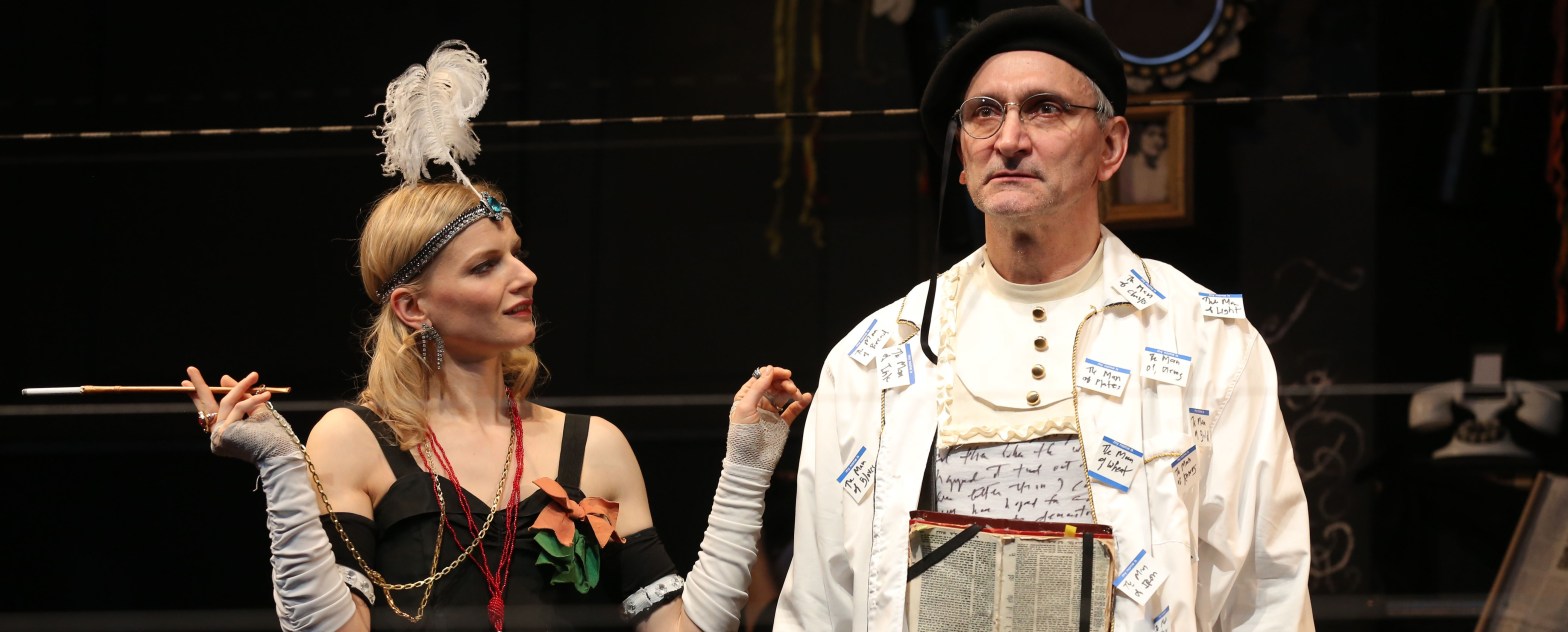
Lea Salonga at The Carlyle

As published in EDGE on May 23, 2013.

After Kobe beef, cheesecake drizzled in peach sauce, and coffee served from silver pots are whisked away, the band, white-haired and dressed in black, tests their instruments on stage. The hum drowns out the dinner chatter as the lights dim. From the darkened crowd appears Lea Salonga, jumping on stage, “Hi y’all, how are you this evening?”Stephen Sorokoff

“Back to Before” at The Carlyle focuses on the international career of Lea Salonga, capturing the struggle of a Filipino woman who has defied all stereotypes and ethnic barriers. Directed by Victor Lirio, Salonga walks you through her career, relating her experiences to strong female characters in American show tunes.

Starting her career in 1978 at the age seven in the musical “The King and I” in the Philippines, she has worked internationally, having performed for five Philippine presidents (from Ferdinand Marcos to Gloria Macapagal-Arroyo) and three American Presidents (George H. W. Bush, Bill Clinton, and George W. Bush).

To read more, click here.

Lea Salonga

Innovating Women: The Changing Face of Technology

As Research & Editorial Director for Innovating Women: The Changing Face of Technology , Van Nest acted as a contributing writer and project manager. She conducted research, fact-checked, and interviewed along with assisting in the management of a crowd-sourced discussion platform made up of over 300 female founders and tech professionals.  To help the book launch, she also aided in the marketing and social media strategy. The book’s indiegogo page can be found here.

Innovating Women

IndieGoGo Campaign

Innovating Women Press Release

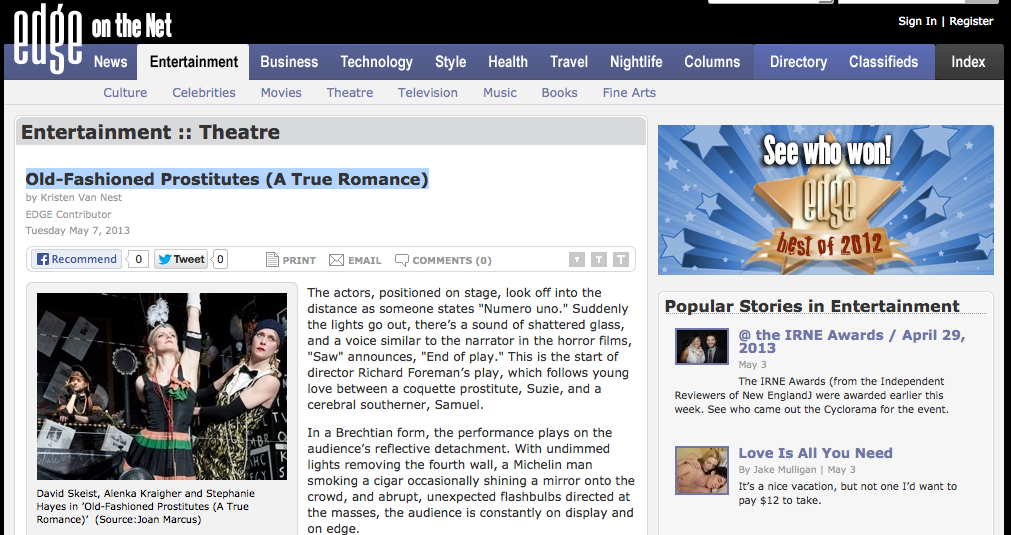
Old-Fashioned Prostitutes (A True Romance)

viewimage_story.php
David Skeist, Alenka Kraigher and Stephanie Hayes in ’Old-Fashioned Prostitutes (A True Romance)’ (Source:Joan Marcus)

As published in EDGE on May 7, 2013.

The actors, positioned on stage, look off into the distance as someone states “Numero uno.” Suddenly the lights go out, there’s a sound of shattered glass, and a voice similar to the narrator in the horror films, “Saw” announces, “End of play.” This is the start of director Richard Foreman’s play, which follows young love between a coquette prostitute, Suzie, and a cerebral southerner, Samuel.

In a Brechtian form, the performance plays on the audience’s reflective detachment. With undimmed lights removing the fourth wall, a Michelin man smoking a cigar occasionally shining a mirror onto the crowd, and abrupt, unexpected flashbulbs directed at the masses, the audience is constantly on display and on edge.

The removal of melodrama demands a high level of acting skill, which is achieved by all the actors in “Old-Fashioned Prostitutes (A True Romance).” Dangling from a bar on the side of the stage like a prostitute on display through a window in a red-light district, Suzie, played by Alenka Kraigher, embodies her characters personal strength and yet constant discontent.

To read more, click here.

Old-Fashioned Prostitutes

I’m a Stranger Here Myself

As published in EDGE on May 2nd, 2013.

“You are really beautiful, look at her,” a slick Mark Nadler, in a Paisley purple silk vest, grey striped button-down, and pinstripe suit coos, taking a woman from the audience’s hand and pulling her from her seat. Commanding her to twirl, she does, unsure what to expect, light upon her.

“Take your bag. Now hold it like this,” he states. As she turns to adjust it, he leaps into the seat next to her husband, and then into his lap. Nadler flirts with the unsuspecting gentleman as the audience laughs.

Photo credit: Carol Rosegg

“I’m a Stranger Here Myself,” written and performed by Mark Nadler, discusses the expatriate experience during the Weimar Republic, recounting the worldwide cultural export as exiled Jews, stripped from their homes, joined creative and scientific communities elsewhere. Nadler parallels their experiences, relevant to his heritage, with his own childhood as an outsider. In a cabaret meets history lecture performance, he explains the context of relevant music of the time as a PowerPoint-style presentation displays black and white photographs of prominent Jewish exiles, popping out of geometric burgundy tiles. He jumps through the expat scenes – Hollywood, Bilbao, Paris, and Berlin – explaining how the Jewish artists established themselves in their forced new homes. At the piano, he sings in French or German, only to follow with a translation and an explanation of context. This string of descriptors makes it less of a concise, traditionally defined ’musical.’ The climax relates more to his personal life than a point in history. Within this framework, he discusses their (and his) difficulty in a want to assimilate, but a want to remain who they (and he) are.

To read more, click here.

I'm a Stranger Here Myself

Who’s Your Daddy?

As published in EDGE on April 22, 2013.

Source:Carol Rosegg
Source:Carol Rosegg

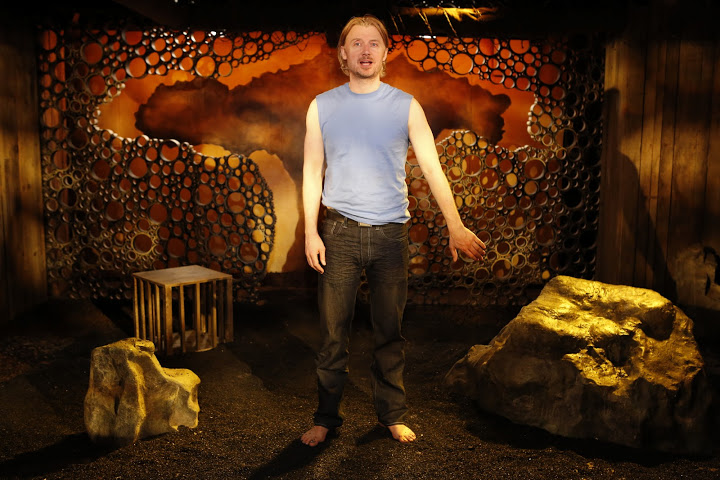
The room lightens from shades of blue to show a hooded form to the left of the stage as “The Lion Sleeps Tonight” plays in the background. With sudden motion, a blonde-haired, blue-eyed O’Callaghan pops out of his hood and screams, “I’m being haunted! By my mother and father — and they’re not even dead!”

After finding his boyfriend with twin lovers, having his beloved dog run away and losing his driving safety job when his rocker-bound boss propositions him, he finds himself without companion or purpose in L.A. Departing on a suicide mission to Uganda in search of a dramatic way to die, he is shepherded by Andrew, a local who runs an orphanage, and Stella, a promiscuous actress who needs a cameraman for her documentary.

Arriving at the orphanage, he is struck by the dire circumstances of the children, who hardly have any food to eat, mold growing in their hair, and multi-colored mucus dripping from their noses onto ashy, scabbed skin. Of the children, Benson takes an instant affection to him, and O’Callaghan, seeing a map of Ireland birthmark in the white of his eye, knows this is his son-to-be.

Written and performed by Johnny O’Callaghan, “Who’s Your Daddy?” is the true tale of the actor’s search for purpose and his adoption of a boy from Uganda. Using his fighting Irish attitude, he battles the obstacles of the U.S. adoption and citizenship process and Ugandan guardianship legalities.

To read more, click here.

Who's Your Daddy

Khmer Arts Ensemble “A Bend in the River”

As published in EDGE on April 10, 2013.

“A Bend in the River” is based on traditional Cambodian folklore, exploring issues of morality, specifically, as put by the performance’s choreographer, Sophiline Cheam Shapiro, “At what cost do we seek revenge?”

The Khmer Arts Ensemble  (Source: Khvay Smanang)
The Khmer Arts Ensemble (Source: Khvay Smanang)

The story is about Kaley, a young girl who is eaten (along with her father, mother and three brothers) by a giant crocodile, Moha, at a bend in a river near a Cambodian village called Kompong Vongkiri. Although Kaley is the main character, the story is told through the narration and point of view of her mother. Prior to her demise, Kaley promises to return in her next life as a larger and stronger crocodile to avenge the death of her mother.

Next, Vichek Moni, the local healer, finds a large egg in the reeds. The egg hatches into a crocodile, which Moni names, in honor of the original, Kaley, not knowing it is actually Kaley reborn. Moni teaches the creature how to transform into a human and swallow ‘him’ temporarily in order to easily transport the healer across the river to aid injured villagers. Once older, Kaley reveals her true identity to Moni, explaining her purpose of revenge. But Moni encourages Kaley to move on and enjoy her new life.

To read more, click here.

Khmer Arts Ensemble

Hamburg Casino Esplanade

The casino is located across from Planten um Blamen park. When you pop up from the metro its vertical stature contrasts the green of the park. The outside is rather plain, except for overbearing columns and a touch of red.

Inside feels like the entrance to a hotel, coats checked to the left. Up the elevator you enter a sterile room: rough red carpet, parent’s basement (cheap attempt at extravagance) bar, people dressed in varying formality, a surprising lack of floozies, and equally spaced tables. A central hallway leads to the back where you can pick up chips from a bank cashier-style counter with two blonds sitting behind thick glass.

Most people are serious. One man, flat out of chips, throws down 500 Euros on the table with a grin. Consistently betting 150 Euros on 0, 7, and 36, he reminds me of a giant slug belching green 50 Euro pellets. He tells me he likes the color of my skirt, petting my hip, as if his overindulgence has bought him the right. Some people put down money and then, not even watching their play, run to another table as if luck has a dog whistle. Watching provides no excitement for jaded eyes.

The woman next to me is edged on by the staff, wanting to win for him as he repeats, “I know you will win this time, OK next time, next time.” On the way out, someone sees their lucky number win, “Oh, I knew I should have played one more time.” They think they can control luck despite the knowledge that odds are stacked against them.

La Cave: A bar in the basement of a Church in Paris

Walking down the icy Rue du Faubourg in the 8th, my hands tucked deep in the pockets of my East Village North Face puffer, I quickly pull one out to check my sticky-note with the address. Coming across ‘hôtel particulier’, I think the tall walls might hide a church. I see the number corresponds to a rather modern, white apartment complex. Peaking into the lobby and checking the door, I enter looking lost. There, through the corridor stands a beautiful old church. As instructed, I turn left, walk down a flight of stairs, through a lobby, take a right towards the room and there it is – a bustling bar.

Welcome to “La Cave,”  started by a friend’s brother and some of the monks about 5 years ago, it was decided to create a space where people could hang out and chat. The place ended up being so successful, the monks opened up similar bars at their other monasteries across France.

At the entrance is a table, with two men and one computer in which they take all your information so you can become a remember and receive your membership ID card. The room is packed; people sit on stools and recline on sofas, clotted in circles to chat. The room is smoky (due to a technicality in French law, it is one of the few places you can still smoke indoors because it is considered “private” since everyone is a member). It’s where the next generation bourgeoisie come for cheap beer and to catch up after a long week of studying. A few monks line the walls, laughing and speaking with some of the members.

At midnight, the volunteer staff calls for all to be silent. A monk stands on a table facing the room. Everyone gathers around him and in unison repeats the Lord’s Prayer (I try to whisper along in English, unable to even start to translate into French to keep up with those around me). Following the prayer, he reads from the Bible a short passage about not coveting what your neighbor has, something of which everyone can relate. Once finished, everyone grabs the stools, creating a chain, passing them back into a small back room to close up shop, prior to a continued night of reveling including an end of Paris Fashion Week party and Carnival masks.

Kafka’s Monkey

As published in EDGE on April 4, 2013.

f4xRNtLaZ-T0a6chXXhNOTQ0Mm_0lOsgI2EnCrlCvBI
Source:Keith Pattinson

A bent-over Kathryn Hunter, dressed in tails and a bowler hat and swinging her arms like an ape, enters the stage. After assessing her surroundings, she reaches a white podium. Gripping the front edges of the podium with the tips of her fingers, she addresses the audience as “Esteemed members of the academy.”

“Kafka’s Monkey,” based on “A Report to an Academy” by Franz Kafka, adapted by Colin Teevan, humorously presents a monkey, Red Peter, describing to a group of academics its transformation from a wild jungle creature to the civilized being before them. In between swigs from a silver flask, the monkey describes being shot from a tree, sea vessel transportation, and its first encounters with humans.

Since it has been five years since the monkey departed from the “Gold Coast,” it apologizes for not remembering its “prior” life. Instead it focuses on its education in how to be a successful man. Thus, the play focuses more on what it means to be human than what it means to be ape.

To read more, click here.

Kafka's Monkey