In China, Under Armour Looks to Brand the Workout Experience

As published on brandchannel.com on October 29, 2013.

Earlier this month, Under Armour introduced a completely different retail concept to the Chinese sporting apparel market—a market that has proven hard to crack even for the most seasoned retail veterans, including Nike and Adidas. But Under Armour’s new Shanghai retail theater experience aims to do much more than just sell clothes and sneakers.

Located in the Jing An Kerry Centre, the store features a 270-degree screen that covers 90 percent of the relatively small boutique, encapsulating store-goes in the sights, sounds and experiences of athletic training—a truly foreign concept in China and greater Asia.

In China, especially, working out is not a common activity. Seeing joggers is a rarity and oftentimes in the gym, Chinese are seen wearing jeans or leather shoes as opposed to sporting apparel. Sports participation is also low due to lack of time, the single child policy, and limited governmental support to popularize sports. But, there is still huge market potential; after the Beijing Olympic Games, there has been dramatic growth in sporting brands.

Still, the market has proven difficult, with Nike, Adidas, and others struggling to localize their retail approach to fit the unique needs of Chinese consumers, both young and old. In fact, Nike and Adidas have spent much of their time in the country with a hard focus on building a lifestyle brandaround young consumers, capitalizing on consumer trends towards creativity and self-expression. Still, Nike recently saw a three percent decline in its China sales while it experienced an increase in all other geographic locations.

So Under Armour, a brand built largely on its popular undergarments, is instead focusing on introducing the idea of athleticism to Chinese consumers, putting retail sales second. “You walk in the store going how do athletes train?” Under Armour CEO Kevin Plank explained in a press release. “In China they don’t exercise, so they’re going, why do I exercise? It’s a tutorial on why would I train.” Guests are greeted by a familiar, athletic face: Michael Phelps, who took home eight gold medals at the Beijing Olympics, serves as the store’s virtual host.

“Wherever we go around the globe, we will lead first with our story and bring the people into the best Under Armour experience possible before we ask them to try our performance apparel and footwear,” said Plank.

The company, which as experienced steady quarter-by-quarter growth over the years, saw a 26 percent increase in revenue in the third quarter ending Oct. 24, growing by over 20 percent for the sixteenth consecutive quarter, according to Seeking Alpha. Netting its highest revenues from apparel, followed by footwear and accessories, the retailer shows a lot of promise—that is if it can maintain its impressive growth rate.

In order to do so, the relatively new retailer is doubling down to turn its largely North American-based business into a global brand. Last year, of Under Armour’s $1.8 billion in revenue, less than 10 percent came from global sales, compared to Nike, where more than half of sales come from outside the US. Plank’s plan is to double overall and international revenues by 2016—a difficult goal, for sure, but one certainly in reach for the hard-nosed company. In fact, Plank says, by the end of the year, Under Armour will have more international offices than those in the US. Beyond China, the brand is especially focused on growth in Latin America, with upcoming opportunities in the 2014 World Cup and 2016 Summer Olympics in Brazil to help make in-roads.

Still, China plays a major role in Under Armour’s ability to become a global leader in sports retail. In the last two years, the brand has opened six stores on Mainland China and one in Taiwan and Hong Kong, and the fact that the company manufactures over 50 percent of its products in Asia makes it easy to distribute new designs quickly to the market as the company expands in the region in the future.

To see the original, click here.

Driving Vanity

As published in FOCUS Magazine in the September 2013 issue.

The Chinese gathered in the art deco auction house near Shanghai’s iconic bund are not seeking priceless antiques or cherished celebrity memorabilia. Instead, hopefuls are here for a more practical reason – to buy a license plate. To curb traffic congestion and air pollution, the Chinese government has rationed license plate distribution in its largest cities such as beijing, shanghai, guangzhou, and guiyang, causing prices to skyrocket.

Established first in Shanghai nearly 20 years ago, the programme sees today’s Shanghainese buying license plates that cost rmb 90,000, three times as much as a cheap car – for example, a Zotye Z100 comes in at rmb 24,000. Hopefuls hire middlemen, who double as scalpers, believing their expertise will give buyers an edge in the online and in-person auctions. As a country with 220,000 driving fatalities a year, locals pay high premiums for plates with lucky eights representing prosperity and avoid those featuring unlucky fours symbolising death. To crack down on scalping, the shanghai municipal government requires winning bidders to keep their license plate for at least three years.

Beijing’s system is more egalitarian but less economically efficient. The city presents 20,000 new plates a month; drivers can either win one through a lottery or pay a rmb 100,000 flat rate. Meanwhile, guangzhou took a goldilocks approach, offering 50 per cent by lottery, 40 per cent by auction and 10 per cent to cars certified as environmentally friendly and energy efficient.

Note: this is a preview of the full article

Refinery29 Resists Growing Pains with Renewed Focus on Content, Consumers

As published on brandchannel on September 27, 2013.

Refinery29 has hardly had a chance to settle into its new, larger office and its updated online digs. With 800 percent revenue growth in the past 24 months, it is the fastest growing company in the media division of Inc. Magazine’s 2013 5000 list. The fashion-focused site uses its strong consumer loyalty to help brands connect with Millennials, a consumer base that spends $200 billion annually, according to Chicago-based investment firm William Blair & Co.

“A lot of marketers are asking a lot of questions or intrigued by how it is they speak with a whole generation of consumers that are growing up with very different viewpoints, and technology, and opportunities, some challenging and some good that the generation before has had to deal with. It’s created a very interesting conversation,” Melissa Goidel, Refinery29’s Customer Relations Officer told brandchannel. “The thing that makes [Refinery29] unique is that we are actually creating the content of the conversation, where as those who play in the space with us are really more of the channel for the conversation.”

Known internally as the ‘R29 wink,’ the site has developed its own voice that is approachable and tailored to its users. As Christine Barberich, Refinery29’s Editor in Chief explained, “Our readers come to us for our own unique point of view, as well as the reactions and conversation from their fellow readers. Our audience feels personally connected to Refinery29, our editors, and our content because we create it with them at the very center of it…we share and talk to each other, we never dictate. And that really does make a reader feel like this experience and content was created expressly for them.”

One way the site achieves its ‘friendly’ nature is by avoiding out-of-reach, aspirational model shots that you might find in Vogue or W Magazine, instead opting for ‘real’ people, sometimes its own employees, to model new trends. The down-to-earth approach stretches across its content, too, with the site presenting a mix of high- and low-fashion in an effort to be relatable on all levels.

“They’ll be Alexa Chung and then another [article] about someone who knows how to rock a pair of Keds in a new way that’s totally dynamite,” said Eben Levy, the Director of User Experience. Women are especially attracted to the site because they can find trends that fit their own style using items that are in their price range or are already in their closet.

But perhaps what has made the site most successful is its ability to mix R29 content among branded, promotional pieces. For one thing, Refinery29 always has a role in the branded content. For instance, Levy exlains that a recent article featuring Levi’s clothing was written and shot by R29, who interviewed 10 entrepreneurs and photographed them in Levi’s attire. For the consumer, this content helps reposition Levi’s from its cowboy image—and protects R29’s content standards.

“[Brands] are coming to us as this authoritative connection to this audience. And they want to engage,” Goidel told brandchannel. “Generally speaking, it starts with activation against this audience because they know we have the credibility and they want to approach them with a new idea—they either have that connection or the consumer doesn’t realize they have that offering or service.”

Its personalized approach, to both readers and brands, is what continues to set Refinery29 apart from its competitors. “It is our business to create amazing content that Millennial women want to engage with and we do that as passionately for brands as we do for our own purposes,”—and it shows.

To read the original, click here.

http://www.brandchannel.com/home/post/2013/09/27/Refinery29-Growth-092713.aspx

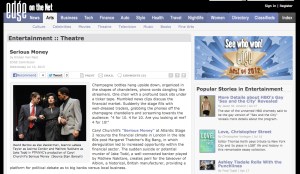
Serious Money

As published on EDGE on July 10, 2013.

Champagne bottles hang upside down, organized in the shapes of chandeliers, phone cords dangling like streamers. One chair with a profound back sits under a ticker tape. Mumbled news clips discuss the financial market. Suddenly the stage fills with well-dressed traders, grabbing the phones off the champagne chandeliers and screaming towards the audience: “4 for 10. 4 for 10. Are you looking at me? 4 for 10!”

Caryl Churchill’s “Serious Money” at Atlantic Stage 2 recounts the financial climate in London in the late 80s post Margaret Thatcher’s Big Bang, in which deregulation led to increased opportunity within the financial sector. The sudden suicide or potential murder of Jake Todd, a well-connected banker played by Mathew Nakitare, creates peril for the takeover of Albion, a historical, British manufacturer, providing a platform for political debate as to big banks versus local business.

Scilla Todd, Jake’s sister who is played by Tara Giordano, seeks to find the murderer of her brother, using his address book to hunt down his enemies. But, her goals change as she realizes how much profit she could make by collecting her brother’s client fees post-mortem, as the Big Bang abolished fixed commission charges. Her thirst for revenge is overpowered by her shock that her brother would not share in the spoils of his semi-legal, financial activity.

Scilla is one example of every character’s prioritization of wealth as the ultimate thrill and achievement. The satire has no moral qualms, as driven characters fight for wealth. During this time of easy money, greed is not seen as a negative. For example, the media positions Billy Corman, played by Alex Draper, as an evil villain seeking the spoils of overtaking Albion.

To combat this perception, his PR executive, played by Dolcie Starr, advises him to downplay ugly greedy, but play up sexy greedy. In other words, a scandal with a prostitute to portray himself as a player to which the everyday man can aspire and as a highbrow, investing in the art to juxtapose the simplicity of Albion’s current management. The only unhappy characters are those no longer able to trade, mainly the ’old money’ crowd that has been replaced with the new trading floor titans.

“Yack, wack, what’s his name? Zach,” Merrisson, an old school banker played by Sten Dykes, exclaims in distaste of the new banker set. The Big Bang new regulations not only benefitted the financial sector as a whole, but also opened the doors of the well-coiffed, old money Oxbridge dominance to gaudy, thick-accented lower class that used their street smarts to thrive on the trading floor.

The clash of the tweed-on-the-weekend class with the new ill-mannered, scrappy market entrants provides an additional layer of comedy. For example, Scilla visits her father with such a character. Before exchanging greetings, the friend asks the square footage of the home, offers to buy it, and daydreams out loud of his future Rottweiler that would roam the estate.

The new lack of regulation also leads to a reliance on relationships to ensure trust within business dealings. Prior to his death, Jake acted as a go-between, aiding in the fundraising process for the buyout of Albion. Everyone trusts Jake’s contacts, although they, as all characters, should not be trusted due to their primary incentive of obtaining more money at any cost. For example, Jacinta Condor, a Peruvian businesswoman, in exchange for a guarantee to purchase Albion shares requests funds for ’hospitals in Peru’, but really her own pockets.

The main theme Caryl Churchill focuses on is not that being pro-business is bad, but that it is individuals who are bad. Every character is greedy and passionately driven by a want for more wealth. The new regulations aided the financial sector in exchange for campaign funds. Churchill explores the culture of this historic period through on-point ’trade language’ and witty rhyming dialog.

The characters effectively use a relatively simple set. The audience feels like insiders as the actors break the fourth wall to provide private anecdotes. But, in time with the financial environment, the dialogs are often very fast with overlapping speakers, making it difficult to follow.

Furthermore, many of the actors play multiple characters. Some, such as Alex Draper, skillfully differentiate their roles, while others less clearly enact a new role. Acts end with a breakout in songs that are quirky, but hard to understand.

This play is ideal for those interested in the financial culture and characters that breed booms and busts. The topics are timely, especially the use of debt as a form of control, in the 80s used by the IMF and today by stronger European countries over their less economically competitive brethren.

Churchill's "Serious Money"

Content Meets Commerce: How Thrillist and Refinery29 Turn Brand Loyalty into Sales

As published on branchannel on July 5, 2013.

Founded in 2004, Thrillist started as a guide to New York City for recent male graduates. Today, Thrillist Media Group generates over $40 million in revenue , 45 percent of which comes from its e-commerce site, JackThreads, which it acquired in 2010 to complement its content offerings on its Thrillist and Crosby Press sites.  Refinery29

Unlike most media companies, Thrillist has over half a million credit card numbers on hand. The seamless shopping experience, where men can discover and purchase product on the same site, means that the user is more engaged and more likely to have intent to buy. “They’ve got their wallet in hand. They’re looking for recommendations and what to do and what to buy,” Eric Ashman, Thrillist Media Group’s strategic advisor told brandchannel. “Reading GQ, your feet are up on the coffee table, you’re leaning back. And when you’re [on Thrillist], you’re leaning forward and looking for ideas and looking for recommendations and things to share with your friends.”

Refinery29, like Thrillist, is also at the forefront of seamlessly joining content and commerce. With 5 million visitors per month, Refinery29 focuses on building brand loyalty for the brands advertised on its site, but without a major complementary online store.

Whether it’s driving sales or driving loyalty, both sites utilize and prioritize content over commerce. “At the Thrillist Media Group, we’re talking about dropping people into a full e-commerce experience, where we run everything from buyers on one end making product and curating product, all the way through to a warehouse where we do fulfillment,” Ashman told brandchannel.

Both sites support the same strategy: content drives users to the sites and engages them to buy, whether its directly or indirectly. Understanding this relationship, the sites focus on content-based metrics such as audience engagement, audience growth, engagement growth, and time on site to measure their success as opposed to solely focusing on direct purchase metrics.

With regular display advertising, a 1 percent click rate is impressive, but on Thrillist, most of the site’s content has a 25 to 30 percent click rate as users seek to learn more or purchase a product. The products highlighted on Thrillist come about through a unique and tested approach that sees the site’s editors choosing which products they want to write about. The process allows for a more natural feel to the curacted content. Through this content focus, brands highlighted on the site receive benefits across the purchase funnel, impacting awareness through loyalty.

Refinery29’s CEO Philippe von Borries said at a recent NewsCred event that, “Famous brands are 50 percent merchandising and 50 percent inspiration. Borries also spoke of the tricky balance faced by e-commerce sites in which online shops seek to minimize time on the site (pre-purchase) while fashion content sites try to maximize time.

Unlike Thrillist, Refinery29 focuses more on brand loyalty without the emphasis on direct purchase. For example, an article on Alice + Olivia’s ‘whimsical’ office has little to do with showcasing the clothing company’s products and yet, develops a relationship with the brand. The site subtly advertises the boutique Nasty Gal in the article, “20 Crucial Fashion Lessons We Learned From Arrested Development”: “All of Rita’s outfits are just amazing, and we’re only about 40 percent joking here. The heart-shaped glasses, smiley pin, Clueless-inspired beret—these are all things that have populated Nasty Gal and more of our favorite downtown-cool shops in the last few seasons.”

Here, unlike what you might find on Thrillist, there is no link to Nasty Gal’s site, only a reference. The upshot: readers may feel they’re getting the insider scoop. The only section of Refinery29 devoted to direct purchases is discount giftcards and small boutiques highlighted as “Vintage Across America,” which clearly differs from Thrillist’s full e-commerce experience.

While both sites have different end goals to monetize their content and communities—Thrillist Media is looking to launch shops on Thrillist and Crosby Press that leverage Jack Thread’s e-commerce platform, while Refinery29 doesn’t alude to any retail expansion—both remain to be trendsetters in a space that aims to marry the disjointed worlds of content and commerce.

For original, click here.

Content Meets Commerce

Be the Death of Me

As published in EDGE on June 30, 2013.

Walking up a creaky, faded yellow staircase of a historic church, guests are handed maps and the quick instructions: “Head to the number of your station on the back. Mind 7 and 8, they are tricky to find.”

Map in hand, everyone scurries into a large, open room. A balcony surrounds the edges, providing an upstairs with a large open center. The room is rather empty except for a mattress with messy sheets, a bicycle, a chair with crayons and toy trucks, and a waiting room-style chair. Upstairs there’s a bar where people can grab drinks in preparation for a night of meetings with various death experts.

“Be the Death of Me,” an investigation, installation performance at the Irondale Center, was developed through months of interviews done by The Civilians creative team. The show covers various aspects of death.

The performance starts by visiting set-up stations in which an actor discusses his experience with death. Next, select monologues are given, with everyone watching a single actor followed by circles of light indicating specific performances, arranged in the main area like the game “Twister.” Guests decide to whom to listen, gathering on the floor around each actor. The show ends with a few additional monologues sporadically appearing one after the next around the theater.

One theme is the future of conscious meets body. For example, a man in glasses describes his obsession with efficiency, juxtaposed as he stands in a cramped stairwell, and how soon our consciences will be uploaded in “the cloud” so that if our bodies are ruined, we can upload our conscience, continuing to live as a robot.

Medical care and cost was another touchy subject as there are the combative forces of the extreme emotion of death and the practicality of this natural phenomenon. For example, one women’s child is born dead. The hospital encourages her to have her child buried on “Heart Island,” as is common procedure, but she feels betrayed to discover her child is buried in a grave of twenty babies.

To visit its “grave,” she may stand on an atrium, overlooking a field of buried dead babies. The theme of the commonality of death emerges again as a funeral house director’s son describes seeing bodies lined up and embalmed, one’s arterial wound flushing blood onto its suit.

The question of how someone should feel about death is also discussed. The women whose child died prematurely feels guilt and regret in not wanting to hold her lifeless baby in the moment following its birth. In another story, a family therapist mentions how a family asked her to speak to their child about the death of her brother. In the therapist’s game, she understood her brother was dead, removing the tube from a doll’s mouth.

At the end of the session, the girl skips out, not sad, but happy that her sibling is in a better place. The parents expected the therapist to make their daughter feel sadness as this is how they felt she should feel. But, children do not always react in the same way as adults.

The main theme is that we are in this life for a purpose and cannot leave until this is fulfilled. When the actors are in pools of light spread across the main floor, the director orchestrated all the characters finish early but one. This allows the audience to eavesdrop on the old man repeatedly asking: “But what is our purpose? Why are you here?”

All the stories originate from New Yorkers, creating an added level of empathy. For example, a graveyard tour director exclaims, “Let’s face it, if you don’t have a lot of money, you are going to have to be buried in Jersey!” In between scenes, a subway car rolling in and out of a station is projected on the wall, a metaphor for our transition through time and space.

The performance portrays various perspectives on death in a captivating way. The constant need to move breaks up the monotony and allows moments for reflection between intense personal stories. The actors effectively re-enact the dialogs, showing the true emotion of the characters and also their reflection on their intense encounters with death and the dying. They effectively portray the rationalizing of the emotional, life changing experiences.

The performance is ideal for all those curious about death. In the first portion and the “Twister” arrangement, there is not enough time to see all the actors, thus make sure to prioritize the scenes that look the most interesting.

For original, click here.

Be the Death of Me

Les Ballets Trockadero de Monte Carlo

As published on EDGE on June 29, 2013.

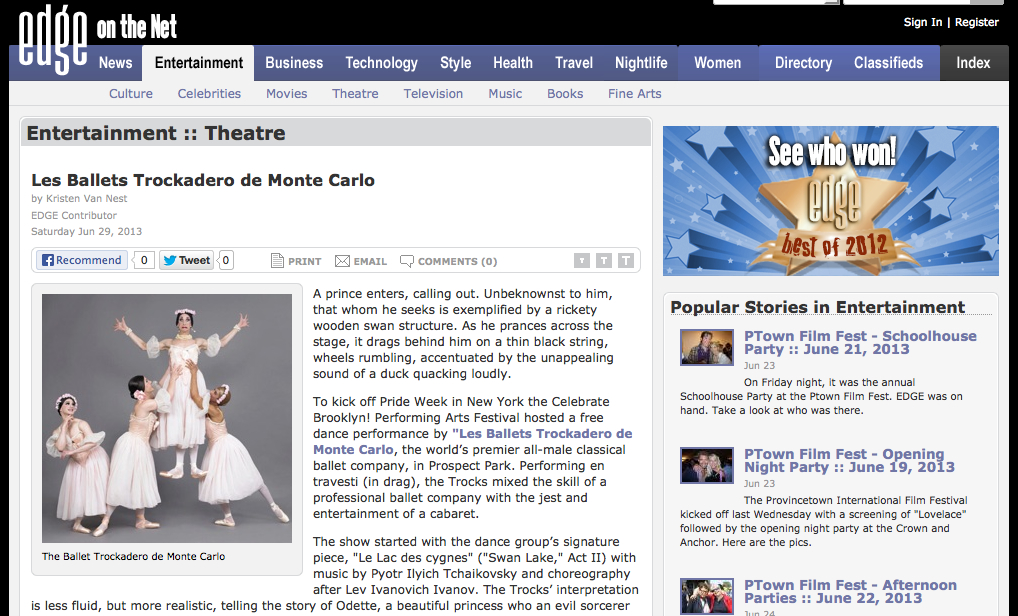
A prince enters, calling out. Unbeknownst to him, that whom he seeks is exemplified by a rickety wooden swan structure. As he prances across the stage, it drags behind him on a thin black string, wheels rumbling, accentuated by the unappealing sound of a duck quacking loudly.

To kick off Pride Week in New York the Celebrate Brooklyn! Performing Arts Festival hosted a free dance performance by “Les Ballets Trockadero de Monte Carlo,” the world’s premier all-male classical ballet company, in Prospect Park. Performing en travesti (in drag), the Trocks mixed the skill of a professional ballet company with the jest and entertainment of a cabaret.

The show started with the dance group’s signature piece, “Le Lac des cygnes” (“Swan Lake,” Act II) with music by Pyotr Ilyich Tchaikovsky and choreography after Lev Ivanovich Ivanov. The Trocks’ interpretation is less fluid, but more realistic, telling the story of Odette, a beautiful princess who an evil sorcerer turned into a swan. Odette enters the stage in a white tutu, hamburger meat chest hair spilling from the lacy bodice.

To read more, click here.

Les Ballets Trockadero de Monte Carlo

This E-Book Will Help Break Glass Ceilings

Published on Mic.com in June 2013. Note: Since publication, the title of the book has changed to Innovating Women: The Changing Face of Technology.

I recently encountered a Reddit thread listing “the most intellectual jokes you know.” Many were indeed nerd wit-laden, but one response caught me off guard. It began: “A physicist, a mathematician and an engineer stay in a hotel. The engineer is awakened by a smell and gets up to check it.” A fire emerges in the hallway, and the three must use their expertise to think of ways to extinguish it.

What troubled me was that the default pronoun used to describe the characters — “he” or “him.” This is emblematic of a persistent cultural assumption that women don’t ever become physicists, mathematicians or engineers. Congress’s Joint Economic Committee reported last year that only 14% of engineers are women, and only 27% are working in computer science and math fields. The same under-representation occurs in leadership positions, as only 4% of women make the Fortune 500 CEO list.

Enter millennial entrepreneur Kristen Van Nest and the team of researchers behind Innovating Women: Past, Present, & Future. The ambitious crowd-sourced e-book and surrounding project aim to shed light on why women are underrepresented in STEM and leadership positions. The title gives us a hint: Women encounter obstacles not just when they enter the workforce, but throughout the course of their lives.

To read more, click here.

For Entrepreneurs, Switching Careers Can Be A Good Thing

As published on Forbes.com on June 4, 2013.

“It is important to understand that innovation happens in many ways. We should not get hung up on thinking an innovation is a massive breakthrough. Innovation often comes in a series of steps,” recommends Kay Koplovitz, Chairman & CEO at Koplovitz & Co LLC and the founder of  USA Network and creator of today’s cable television business model. Those most successful in entrepreneurship understand that regardless of where they were in their career, acquiring new skills was critical to the innovation process. On a day-to-day basis, they followed their passions on undefined paths, not expecting leaping breakthroughs, but understanding that each step would lead to new opportunities.

For an upcoming book, Innovating Women: Past, Present & Future, co-authored by Vivek Wadhwa and Farai Chideya, top female entrepreneurs shared their stories on how they reached the top, developing the broad, yet specialized knowledge-base necessary to create innovation within their fields. Their anecdotes provide insight as to how aspiring entrepreneurs can educate and prepare themselves to start their own firms.

For Alison Lewis, named one of the Most Influential Women in Technology in 2010 by Fast Company and founder of Agent of Presence, a fashion technology firm, she wanted to create unique experiences using fashion. Lewis realized her graphic design skills were not enough to support her passion of technology-based design. At the age of 28, she learned electrical engineering from scratch: “To step into electronic engineering, it was scary. I just really wanted to make stuff, jewelry that responded when loved ones were thinking about each other, or I wanted to make garments that when you hugged them, they responded to you. The power and the will to want to make something in a space where you feel free to want to make something, makes it a lot easier to learn.” The label ‘designer’ did not limit her, but instead she created an environment in which she could be whatever she wanted to be, surrounding herself with supportive and innovative creators in Parson’s Design & Technology program. This made her comfortable adding ‘electrical engineer’ to her repertoire.

To read more, click here.

Switching Careers

Networking… Ladies, You’re Doing it All Wrong

As published on Forbes.com on May 28, 2013.

What motivated me to join the editorial team of Innovating Women: Past, Present & Future, co-authored by Vivek Wadhwa and Farai Chideya, was the real need for women to hear true stories about how other women strategized in their careers and rose to the top. One of the topics that has particularly hit home is the need to attend conferences and seek out mentors.

In my first job out of college as a branding consultant, to help our clients, we would look for ‘analogs,’ or how companies in different industries had overcome and tackled problems similar to those of our patrons in innovative ways. In my career, I search for ‘personal’ analogs, or people who have achieved goals similar to my own in order to study and understand their strategy and path to reach success. Repeatedly our ambassadors in Innovating Women: Past, Present & Future have spoken about how conferences have helped them find role models and mentors within their fields. Unfortunately, they also spoke of how too few women are taking advantage of these opportunities.

“For the first time in my life I went to the bathroom and noticed a big line outside the men’s room… I got into the lady’s room and found two girls in there, we all had the same reaction,” says Danielle Newman, founder of StartupByte, about her experience at Startup Weekend: “We were laughing hysterically that we were the only girls, a total of 4 girls participating in the event with about 80 men.”

To read more, click here.

Forbes_Networking