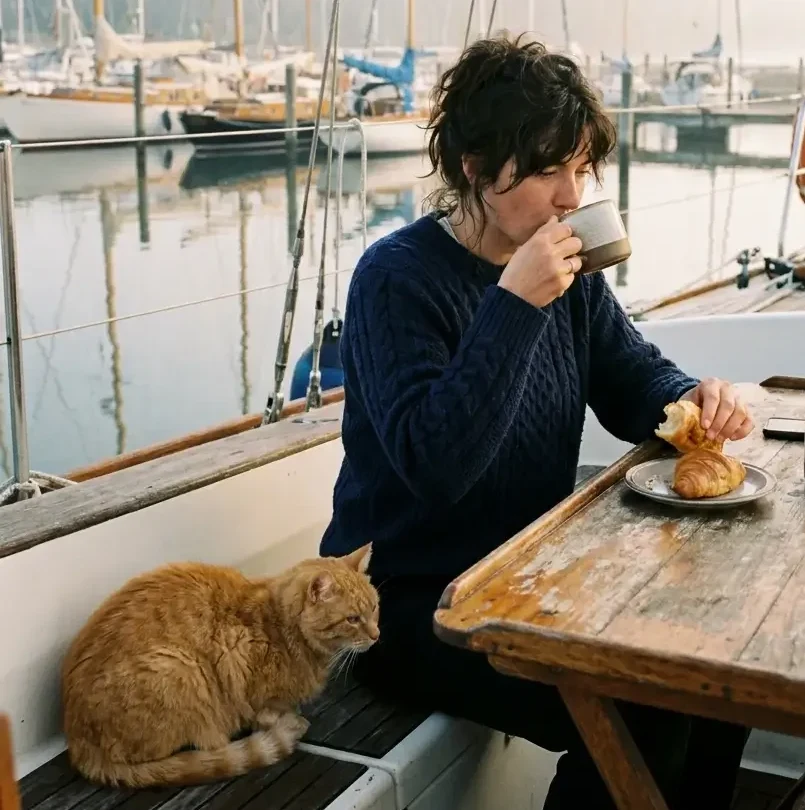
I dedicated my memoir Where to Nest to the love of my life — my cat Nala. She’s a ginger rescue who was pulled out of a taxi engine in Shanghai (it took ten men and a car jack), flew thirteen hours to Toronto with me where we had a snowy layover (I slept in an airport chair with my moving sheets while she purred on my chest) and eventually made it to our apartment in Koreatown, LA, where she eats grass in the courtyard on a leash and judges me from the kitchen counter while I write thrillers at 2am.
So when I went looking for cat mystery books (real dark cat mystery books, not cozy cat detectives) I expected to find my people. Instead I found approximately nine thousand cozy mysteries where a tabby named Mittens solves a murder at a bed-and-breakfast while her owner bakes scones. I have nothing against scones. But my reading taste is: I want anything that has a dead body.
Cats make everything better, so why not add them to dark mysteries? Turns out, some of the best horror and psychological thriller writers already have — they’ve just been buried under an avalanche of cozies. These are the cat mystery books I actually wanted to find: twisted, dark, occasionally terrifying fiction where cats are companions, narrators, nightmares, and witnesses to the worst humanity has to offer. Not a single one involves a cat solving a crime with its owner over chamomile tea. These are the cat mystery books I wish someone had handed me years ago.
Want a cat-mystery with sharper teeth than the cozy lane?
Get the first few chapters of The Storm Reaper free — a Fire Island serial-killer thriller narrated by a sarcastic detective whose entire support system is an opinionated orange cat named Purrmaid who sits on her corkboard full of dead people. The lead detective has been called a liar for a decade. Will anyone listen before the killer strikes again?
★★★★★
“I actually loved all the characters.”
— Mary, Goodreads Reviewer
Why Cat People Make the Best Thriller Readers
There’s actual science behind why cat people gravitate toward dark fiction — and the reason runs deeper than all of us being quietly unhinged (though that helps).
Research from Psychology Today found that cat lovers are 15% more introverted than dog people, and (here’s the kicker) 11% more open-minded. That openness correlates with appreciation for unusual ideas, complex emotions, and the kind of moral ambiguity that makes a great psychological thriller tick. Cats are, as the researchers put it, “suited to providing company to a person at home engaging in solitary activities (such as reading a book).” Or in my case, reading a book while my cat angrily looks at me for not giving her attention 24/7 — after all, I am her assistant.
Cat mystery books should reflect that — independent, a little unpredictable, comfortable in the dark. And we’re not a small club. The American Pet Products Association reported in 2025 that 49 million US households now own cats — a 23% jump from 2023. Multi-cat homes are up 36% since 2018. Gen Z cat ownership surged 25% year-over-year. The cat people aren’t coming. They’re here. And they want thriller books with cats that go harder than a tabby solving a bake sale poisoning.
The thing is, the “cat mystery” genre is dominated by cozies — and I genuinely love that those exist. Cozy mystery authors have built something wonderful, and those books make a lot of readers really happy. Search “mystery books with cats” and you’ll find the Cat Who series (30+ books), Cat in the Stacks, and the Bookmobile Cat. They’re great at what they do. But if you’re like me and your reading taste leans toward dead bodies, psychological mind games, and horror that keeps you up at 3am — where are the cat mystery books for us? The thrillers for cat lovers? The horror novels where cats are witnesses to actual violence?
These cat mystery books exist. You just have to dig for them. So I did.
9 Cat Mystery Books That Aren’t Cozy Mysteries
1. The Last House on Needless Street by Catriona Ward (2021)
A cat narrates a psychological horror novel — and she’s not solving crimes. She’s hiding them.
Olivia is one of three narrators in Catriona Ward’s British Fantasy Award-winning novel, alongside her owner Ted and his daughter Lauren. Ted lives in a boarded-up house on a dead-end street. Olivia reads the Bible in her spare time, naps compulsively, and believes her purpose is to protect Ted from something she can’t quite name. Her chapters are written with the same literary precision as the human narrators, and her disinterested feline observations (characteristically cat-like in their selective attention) slowly reveal that the story you think you’re reading is not the story at all.
I won’t spoil it. But the twist reframes everything Olivia has told you, and it is devastating.
If you loved the isolated, claustrophobic energy of the thrillers on my island thriller books list, Ward’s novel takes that same trapped-nowhere feeling and multiplies it. If you’ve ever wondered what a cat would actually notice about a crime scene (the textures, the sounds, the things humans overlook because they’re too busy panicking) this is that book. Ward won the British Fantasy Award for Best Horror Novel and was a BBC Two Book Club pick. Dark books for cat lovers don’t get better than this.
2. The Storm Reaper by Kristen Van Nest (2026)
I’m going to admit up front that Purrmaid (Officer Violet Crisp’s ginger tabby) does not solve the case. What she does is better. She sits on the corkboard. She bats pins onto the floor when dinner is late. She lives on the sailboat in the bay on Fire Island, New York. She is Violet’s entire support system, and when Violet comes home from a homicide scene with her back aching and her hands still shaking, Purrmaid is the one who looks at her like you got held up at the office again, idiot, where’s my dinner? She’s based on my own cat, Nala.

The cat is the closest thing Violet has to a confidant, and the only thing on the island that doesn’t judge her based on her past. Violet has spent a decade trying to prove that a serial killer uses hurricanes to disguise murders as storm-related deaths. Nobody believed her. Purrmaid didn’t care either way, but at least she doesn’t dismiss her for it.
Who it’s for: Cat people who want a thriller where the cat matters but doesn’t wear a tiny detective hat. Purrmaid is emotional support, property damage suspect, and intruder detector. That’s enough.
Serial Chillers Verdict: A storm thriller with a cat who holds grudges. Not a cozy mystery. Not even close. Read it now.
3. Pet Sematary by Stephen King (1983)
Church the cat comes back. Church the cat comes back wrong.
Stephen King (who also made my list of the best serial killer thrillers) has said this is the novel that scared even him. Scared him enough that he shelved the manuscript and only published it because he owed his publisher a book. The premise: the Creed family’s cat, Church (short for Winston Churchill), gets hit by a truck on the highway near their new home in rural Maine. Their neighbor shows Louis Creed a burial ground beyond the pet cemetery. Louis buries Church there. Church comes back.
But Church is different now. His fur is matted and oily. He smells like death. He catches mice and birds not to eat them but to leave them, half-alive, twitching on the doorstep. His eyes have gone flat and wrong. And Louis, who should stop right there (who should recognize this for the warning it so clearly is) doesn’t stop.
The cat is the canary in the coal mine of this novel. Everything that happens after Church returns is Louis’s fault for ignoring what the cat was telling him. The 2019 film adaptation with Jason Clarke leans into Church’s wrongness beautifully. The 2023 Paramount+ prequel, Pet Sematary: Bloodlines, goes even further back.
4. We Have Always Lived in the Castle by Shirley Jackson (1962)
Merricat Blackwood is one of the most unsettling narrators in American fiction. Her cat Jonas is the only creature she trusts completely.
Shirley Jackson’s final novel follows Merricat (Mary Katherine) and her sister Constance, who live in self-imposed isolation after most of their family was poisoned at dinner. The townspeople despise them. Merricat performs small rituals (burying objects, nailing items to trees) to protect the property. Jonas accompanies her on every walk, every ritual, every act of boundary-setting against the outside world.
Jonas gets no dialogue and no POV. He’s something more atmospheric than that. He’s Merricat’s familiar — a living extension of her isolation, her wildness, her refusal to participate in the world that rejected her. When the 2018 film adaptation cast Taissa Farmiga as Merricat, Jonas became the visual anchor of her alienation. You can’t separate Merricat from her cat without the whole thing falling apart.
Jackson also made my list of feminist horror novels — her work is foundational to the genre. This is gothic psychological fiction at its most claustrophobic. The cat doesn’t solve a mystery. The cat is the mystery — what it means to be bonded to someone who might be a monster.
5. Felidae by Akif Pirinçci (1989)
A cat noir detective novel. And before you say “that sounds cozy” — it won Germany’s best crime novel prize and features a subplot about eugenics experiments on cats that parallels Nazi atrocities.
Francis is a domestic cat who moves to a new neighborhood and discovers that local cats are being brutally decapitated. He investigates. The trail leads through a network of cat breeds, a secret cult, and an underground crypt where something genuinely horrific has been happening for decades. The violence is explicit. The moral questions are real. Francis isn’t adorable — he’s a hardboiled detective who happens to be covered in fur.
The 1994 German animated film is infamous for being marketed to children and traumatizing an entire generation of German kids. (Dark animation was apparently just what the ’90s were into.) The English translation of the novel is harder to find but worth tracking down. This is the only cat mystery book on this list where the cat is literally the detective, and it’s on this list because it’s darker than most human-detective thrillers I’ve read.
6. Kafka on the Shore by Haruki Murakami (2002)
Talking cats. A serial cat killer. A metaphysical quest that bends reality until it snaps.
Murakami’s novel follows two parallel stories: a fifteen-year-old runaway named Kafka Tamura and an elderly man named Nakata who lost his ability to read but gained the ability to speak with cats. Nakata works as a finder of lost cats, which sounds charming until he encounters Johnnie Walker (not the whisky, a man dressed like the whisky mascot) who is methodically killing neighborhood cats and collecting their souls to build a supernatural flute.
That sentence is not a fever dream. That is the actual plot.
The cats in Kafka on the Shore are not metaphors. They’re characters with names and personalities who hold conversations with Nakata about the weather, their owners, and the meaning of existence. The English translation (2005) turned the novel into an international phenomenon. Murakami uses cats the way other writers use weather — to signal that reality is about to shift beneath your feet.
Want a cat-companion thriller with a real body count?
Get the first few chapters of The Storm Reaper free — the lead detective comes home from homicide scenes to the only living creature she’s never had to prove anything to: her stubborn ginger cat named Purrmaid. Then the next hurricane rolls in. Can she catch the killer before he takes another victim?
★★★★★
“Could not put the story down once I started it.”
— Hannah Rhoades, Goodreads Reviewer
7. Coraline by Neil Gaiman (2002)
The Black Cat has no name. He doesn’t need one. He’s the only character in this book who sees the Other Mother for what she really is — and he’s not impressed.
Neil Gaiman’s novella follows Coraline Jones, who discovers a door in her flat that leads to an eerily perfect version of her life. The Other Mother has buttons for eyes and wants Coraline to stay forever. Everyone in the Other World is a puppet except the Black Cat, who moves freely between realities because, as he explains, cats have always known how to slip between worlds. He’s sarcastic, independent, and deeply uninterested in performing warmth — which is exactly what makes him trustworthy in a story where every other creature is trying to manipulate Coraline.
The 2009 stop-motion animated film by Laika Studios made the Black Cat even more iconic. He doesn’t speak in the Other World sequences — just acts, with terrifying precision. This is horror-adjacent fiction where the cat behaves exactly how you’d expect a real cat to behave if confronted with an interdimensional parasite: total disdain, occasional assistance, zero unnecessary loyalty.
My cat Nala has that same energy. She’d look at the Other Mother and yawn.
8. The Black Cat by Edgar Allan Poe (1843)
Every dark cat mystery on this list traces back here.
Poe’s short story is narrated by an unnamed alcoholic who describes his descent into madness through his relationship with his black cat, Pluto. He adores the cat. He gets drunk. He cuts out the cat’s eye. He hangs the cat from a tree. A new black cat (identical to Pluto but with a white mark on its chest) appears. The narrator tries to kill this one too, misses, and kills his wife instead. He walls her body up in the basement. The cat, of course, is inside the wall with her.
Published in the Saturday Evening Post in 1843, “The Black Cat” invented half the tropes that cat mystery books (and dark fiction in general) still use: the unreliable narrator, the guilt made physical, the animal as psychological mirror. The cat isn’t a character with agency — it’s a manifestation of everything the narrator is trying to bury. And it won’t stay buried.
If you’ve never read it, it takes about twenty minutes and it will ruin your afternoon. Britannica’s analysis positions it as foundational to the psychological horror genre. Boris Karloff starred in the 1934 film adaptation.
9. Twists of the Tale: An Anthology of Cat Horror edited by Ellen Datlow (1996)
Twenty-three dark short stories where cats are heroes, villains, supernatural agents, and everything in between — and not a single cozy among them.
Ellen Datlow is one of the most respected horror anthology editors alive, and this collection is her definitive statement on cats in dark fiction. The stories range from psychological to supernatural to outright weird, featuring domestic cats, mythical cat beings, and people transformed into cats. Stephen King’s “The Cat from Hell” (about a hit man hired to kill an elderly pharmaceutical mogul’s cat) is the kind of energy this entire collection runs on. What unites them is that every story takes the cat seriously as a source of terror, fascination, or both.
This is the best entry point if you want to sample the full range of what dark cat fiction can do. Some stories will haunt you. Others will make you look at your own cat differently. All of them lean into what makes cats genuinely unsettling: they’re watching. And they’re keeping score.
If you want the widest range of cat mystery books in a single volume (without a single cozy in sight) this anthology is your bible.
Read Next
If you loved these twisted cat mystery books, check out my list of books like Thrash — shark and hurricane thrillers for more dark fiction where nature is the weapon, not the scenery.
Want the first chapters of an island thriller with a cat sidekick free?
Get the first few chapters of The Storm Reaper free — a barrier-island whodunit told by a detective who lives on a boat with her cat Purrmaid and hunts a serial killer who uses hurricanes for cover. She’s finally close enough to catch him — but how does she catch him when it means arresting someone she loves?
★★★★★
“Absolutely gripping plot that I couldn”
— Melinda Smith, Goodreads Reviewer
Cat Mystery Books FAQ
What Are the Best Cat Mystery Books That Aren’t Cozy?
The best non-cozy cat mystery books include The Last House on Needless Street by Catriona Ward (a cat narrates a psychological horror novel), Pet Sematary by Stephen King (the most famous cat in horror fiction), and We Have Always Lived in the Castle by Shirley Jackson (a gothic masterpiece where the cat is the protagonist’s familiar). For short fiction, Twists of the Tale edited by Ellen Datlow collects 23 dark cat horror stories. Cozy cat mysteries are wonderful in their own right — these picks are just for readers who prefer their cat fiction with a body count.
Are There Psychological Thrillers With Cats?
Yes — and the best is The Last House on Needless Street by Catriona Ward, where a cat named Olivia narrates chapters of a psychological horror that won the British Fantasy Award. Kafka on the Shore by Haruki Murakami features talking cats and a serial cat killer in a literary thriller that bends reality. Edgar Allan Poe’s “The Black Cat” (1843) invented the psychological thriller with cats as dark mirrors of human guilt.
What Is the Darkest Cat Mystery Book?
Pet Sematary by Stephen King might be the darkest — it’s the book that scared King himself enough to shelve it. The family cat Church returns from an ancient burial ground as something malevolent, and his transformation sets off a chain of horrors. For pure noir, Felidae by Akif Pirinçci features brutal cat murders and eugenics experiments. For literary darkness, Shirley Jackson’s We Have Always Lived in the Castle pairs a cat with a narrator who may be a killer.
Why Are Most Cat Mystery Books Cozy Mysteries?
Cat mysteries became synonymous with cozies because the cozy genre adopted cats as a branding staple (cats signal domesticity, comfort, and smallness of scale) all hallmarks of the cozy subgenre. Series like the Cat Who books (30+ titles) cemented the association, and those books have a huge, devoted readership for good reason. But dark fiction has always featured cats too — from Poe in 1843 to Catriona Ward in 2021. If your taste runs darker, those books exist. They’re just harder to find because the search results are dominated by cozies.
Do Any Horror Books Feature Cats as Main Characters?
Several. The Last House on Needless Street gives a cat full narrator status in a horror novel. Pet Sematary makes Church the cat the most important character in Stephen King’s scariest book. Felidae stars a cat detective investigating murders in a noir thriller. Coraline by Neil Gaiman features a Black Cat who guides the protagonist through a supernatural nightmare. And Twists of the Tale collects 23 horror short stories where cats are central to every plot.
What are the best cat mystery books?
The best cat mystery books pair a clever sleuth with a feline sidekick who steals every scene. In The Storm Reaper by Kristen Van Nest, Fire Island police officer Violet Crisp works a serial-killer case alongside her cat, Purrmaid — a cat mystery with genuine menace under the cozy surface.
Do cat mystery books have to be cozy?
Not anymore. Many cat mysteries are gentle cozies, but a growing number play for keeps. The Storm Reaper is proof a cat mystery book can be a full-blooded thriller — Purrmaid keeps Violet company while she hunts a killer the locals blame on an island legend.
What cat mystery book should I read first?
If you want a cat mystery with teeth, start with The Storm Reaper, the first in Kristen Van Nest’s Violet Crisp series, where the detective’s cat Purrmaid is along for a very un-cozy Fire Island investigation.
What are the best cat detective books?
Lilian Jackson Braun wrote twenty-nine novels about a reporter named Jim Qwilleran and his Siamese cat Koko, who keeps turning up the clues before he does. She published at least one a year from 1986 to 2007, which is a lot of cat. Akif Pirinçci wrote the only cat detective I’ve found who works a case with real bodies in it. Francis moves into a shabby German apartment building, finds murdered cats, and works his way up to a cult worshipping a genetically engineered tom named Claudandus.
Is there a cat mystery book series?
Yes. Lilian Jackson Braun wrote twenty-nine Cat Who novels between 1966 and 2007, with an eighteen-year gap in the middle, and all of them are cozies. Readers who want the same thing without the scones have one option: Akif Pirinçci’s eight Felidae books, of which only the first three were ever translated. You get Felidae, Felidae II and Cave Canem and then you hit a wall in German. I write one too. The Storm Reaper came out this June, Violet Crisp’s first. Her cat Purrmaid spends it batting pins off the corkboard whenever dinner runs late.
Some links in this post are affiliate links, meaning I may earn a small commission if you buy through them — at no extra cost to you.

Leave a Reply